Bridge Engineering and Revenue — The Sales Persona
By the end of this page, you will understand how the Sales Persona communicates product value, gathers market feedback, and bridges the gap between engineering output and business revenue.
Go-to-Market — The 2-Minute Overview
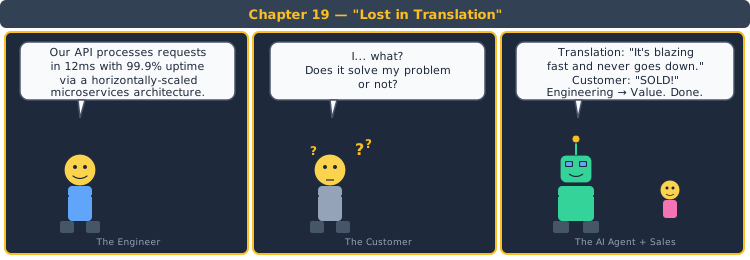
Think about the last time you recommended a restaurant to a friend. You didn't list the ingredients or cooking techniques — you said "the pasta is incredible, the atmosphere is cozy, and it's worth every penny." You translated the product (food) into value (experience worth paying for). That translation is the Sales Persona's job — turning engineering capabilities into customer value propositions.
You Already Know Go-to-Market — You Just Don't Know It Yet
You've been a Sales Persona every time you organized a fundraiser.
💰 The Fundraiser Analogy
Step 1 — Value proposition: "Your $50 feeds 10 families for a week." Not "We buy bulk rice at wholesale."
🔗 Sales Layer: ① VALUE PROPOSITION — Translate features into customer outcomes. Not "our API handles 10K req/sec" but "your checkout never goes down during Black Friday."
Step 2 — Market feedback: "Donors say they'd give more if they could see where money goes."
🔗 Sales Layer: ② MARKET FEEDBACK — Gather customer feedback and loop it back to Product for roadmap decisions.
Step 3 — Revenue loop: More transparency → more donors → more revenue → more impact.
🔗 Sales Layer: ③ REVENUE LOOP — Feature adoption drives revenue. Revenue funds more features. The loop must be intentional.
The Complete Mapping
| Fundraiser | Sales Persona | Phase |
|---|---|---|
| "$50 feeds 10 families" | Feature → customer outcome translation | ① Value Proposition |
| "Donors want to see where money goes" | Customer feedback → product roadmap | ② Market Feedback |
| More transparency → more donors → more revenue | Feature adoption → revenue → reinvestment | ③ Revenue Loop |
The 4 Pillars of the Sales Persona
1. Value Proposition Design
Customers don't buy features — they buy outcomes. Your job is to map features to outcomes.
For every feature, answer: "So what?" The API is fast → "So what?" → Checkout never fails under load → "So what?" → You never lose a sale during peak traffic → "So what?" → You make more money. That last "so what" is the value proposition.
| Concept | What It Means | Example |
|---|---|---|
| Feature → Benefit | What the product does → what the customer gains | "Auto-scaling" → "Zero downtime during traffic spikes" |
| Benefit → Outcome | What the customer gains → business impact | "Zero downtime" → "No lost sales during Black Friday" |
| Outcome → Value | Business impact → dollar value | "No lost sales" → "$500K revenue protected" |
2. Market Feedback Loop
The best product roadmap is written by customers — not in a vacuum.
Gather feedback systematically: customer interviews, support ticket analysis, win/loss analysis (why did we win or lose the deal?), and usage data. Feed it back to Product with evidence and priority.
| Feedback Source | What It Reveals | Cadence |
|---|---|---|
| Customer Interviews | Unmet needs, feature requests | Monthly |
| Support Tickets | Pain points and friction | Weekly analysis |
| Win/Loss Analysis | Why deals closed or didn't | Per deal |
| Usage Data | Which features are adopted | Real-time dashboards |
3. Sales Enablement Materials
A sales team without enablement materials is an improv team — sometimes brilliant, usually inconsistent.
Enablement materials: product one-pagers, competitive battle cards, ROI calculators, demo scripts, and objection-handling guides. These ensure every sales conversation is consistent and value-driven.
| Material | Purpose | Update Cadence |
|---|---|---|
| Product One-Pager | Quick product overview for prospects | Every major release |
| Battle Card | Competitive positioning (us vs. them) | Quarterly |
| ROI Calculator | Quantify value for specific customer | Per deal |
| Demo Script | Consistent product demonstration | Monthly |
4. Revenue Metrics
Revenue is the ultimate validation of product-market fit.
Track: Monthly Recurring Revenue (MRR), Customer Acquisition Cost (CAC), Lifetime Value (LTV), churn rate, and Net Promoter Score (NPS). These metrics close the loop: features → adoption → revenue → feedback → better features.
| Metric | What It Measures | Target Direction |
|---|---|---|
| MRR | Monthly revenue | ↑ Growing |
| CAC | Cost to acquire a customer | ↓ Decreasing |
| LTV | Revenue from a customer over their lifetime | ↑ Growing |
| Churn | Customers leaving | ↓ Decreasing |
| NPS | Customer satisfaction and advocacy | ↑ Growing |
The Complete Mapping
| # | Pillar | What It Answers | Key Decision |
|---|---|---|---|
| ① | Value Proposition | Why should customers buy? | Feature → benefit → outcome → value |
| ② | Market Feedback | What do customers need? | Interviews, tickets, win/loss, usage |
| ③ | Enablement Materials | How do we sell consistently? | One-pagers, battle cards, demos |
| ④ | Revenue Metrics | Is it working? | MRR, CAC, LTV, churn, NPS |
Try It Yourself — A Starter Prompt for Go-to-Market
You are a Sales Enablement Strategist bridging engineering and revenue.

I need a go-to-market plan for:

{{PASTE YOUR PRODUCT FEATURES AND TARGET MARKET}}

Cover these 4 areas:

1. VALUE PROPOSITION — For each major feature, create the Feature → Benefit → Outcome chain.
2. MARKET FEEDBACK — Design a feedback collection plan: what sources, what questions, what cadence.
3. ENABLEMENT MATERIALS — List the materials needed and outline content for a product one-pager.
4. REVENUE METRICS — Define the KPIs to track and their targets.

For each area, provide: the plan and a brief justification.
What This Prompt Covers vs. What It Misses
| Skill | Lite Prompt (Free) | Full Prompt (Course) | Impact of Missing It |
|---|---|---|---|
| Value proposition chain | ✅ Covered | ✅ Covered | — |
| Feedback plan | ✅ Covered | ✅ Covered | — |
| Competitive positioning | ❌ Missing | ✅ Detailed battle cards with "us vs. them" per feature | Sales call: "How are you different from [competitor]?" Sales rep: "Umm… we're better?" Deal lost. |
| Customer persona mapping | ❌ Missing | ✅ Different value props per buyer persona | CTO cares about reliability. CFO cares about cost. Same pitch for both = neither convinced. |
| Objection handling | ❌ Missing | ✅ Top 10 objections with prepared responses | "Your product is too expensive." Sales rep: silence. No prepared response. |
| ROI calculation methodology | ❌ Missing | ✅ Calculator with customer-specific inputs | "Show me the ROI." Sales: "It's great." Customer: "Show me the numbers." No calculator. |
The Lite Prompt gets you to ~60% quality. Good enough to pitch. Not good enough to close consistently.
Real-World Example: GTM for an AI-Powered Code Review Tool
The Requirement
"Create GTM strategy for an AI code review tool: automated PR review, security vulnerability detection, and coding standards enforcement. Target: engineering teams 10-50 people."
Lite Prompt Output
① Value: "AI reviews PRs in seconds, not hours" → "Faster shipping" → "More features per quarter."
② Feedback: Monthly customer interviews. Weekly support ticket review.
③ Materials: Product one-pager, demo script, pricing page.
④ Metrics: MRR, CAC, churn, NPS.
What a VP of Sales Would Catch
| Area | Lite Says | What's Missing | Consequence |
|---|---|---|---|
| Value | "Faster shipping → more features" | No quantification. How much faster? ROI? | Customer: "How much time will we save?" Sales: "A lot." Not enough for a procurement decision. |
| Feedback | "Monthly interviews" | No win/loss analysis. Why are deals closing or failing? | 20 demos, 5 closes. Why not the other 15? No data. Same pitch, same conversion rate. |
| Materials | "One-pager, demo, pricing" | No competitive battle card. 3 competitors exist. | Demo goes well. Customer: "How are you different from CodeRabbit?" Silence. |
| Metrics | "MRR, CAC, churn" | No funnel metrics. Where do prospects drop off? | Plenty of leads, few closes. Where's the drop-off? Demo? Pricing? Evaluation? No visibility. |
Ready to Bridge Engineering and Revenue?
- ✅ The complete prompt with battle cards, ROI calculators, and objection handling
- ✅ An AI agent that communicates product value and generates enablement materials
- ✅ Assessment + coding challenges to verify you can sell, not just describe value
Go from "I understand the product" to "I can communicate its value and close the deal."